





For years, the conversation about Linux on the mainframe was mostly theoretical — a promising idea living at the edge of enterprise strategy. That conversation is changing. A confluence of data points from the 2026 Arcati Mainframe User Survey, BMC’s 20th annual Mainframe Survey, IBM’s own performance testing, and broader enterprise Linux market trends suggests that Linux on IBM Z infrastructure is moving from the periphery toward something more deliberate and durable.
This is not a story about Linux replacing z/OS. It is a story about two platforms finding each other increasingly useful, and about why that relationship is likely to deepen.
The Foundation: Mainframes Are Not Going Anywhere
Before discussing Linux’s growth on the mainframe, it is worth establishing what Linux is growing alongside.
The 2026 Arcati Mainframe User Survey makes the economic stakes plain: over 78% of respondents reported that their business revenue or transactions are totally dependent on the mainframe. A further 36% said more than half of all business revenue runs on mainframe applications. These are not marginal systems. They are the financial gravity at the center of some of the world’s largest enterprises.
BMC’s 2025 Mainframe Survey reinforces that picture with a striking confidence figure: 97% of mainframe professionals view the platform as a long-term platform or one positioned for new workloads, the highest level of optimism recorded across the survey’s entire history. That is not a community bracing for decline. It is one preparing for expansion.
That context matters because it reframes what Linux on Z actually means. It is not a migration strategy or an exit ramp. It is an expansion as organizations extend a platform they already trust into new workload categories that their traditional z/OS environments were not designed to handle.
The Arcati data reinforces this. Nearly 70% of surveyed organizations are actively integrating across platforms. The friction they report is not about whether to stay on IBM Z. It is about visibility, coordination, and governance at the integration boundary. Linux on Z, in many cases, sits directly at that boundary, bridging transactional systems of record with modern application patterns.
LinuxONE: Targeted, But Growing
For the first time, the 2026 Arcati survey asked respondents directly about IBM LinuxONE adoption. Seventeen percent of respondents reported currently operating a LinuxONE system — meaningful, but not yet mainstream.
That number, however, likely understates the direction of travel. A separate survey conducted by PopUp Mainframe found that 94% of mainframe-dependent organizations indicated the potential to leverage extra workload capacity on specialist or Linux environments on Z. Current adoption at 17% against a potential addressable base of 94% suggests significant runway ahead.
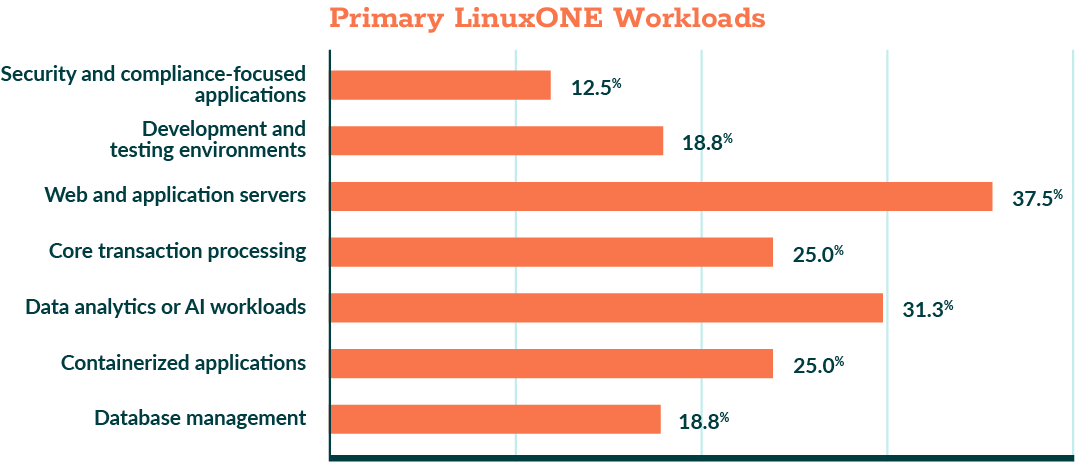
Among current LinuxONE users, the Arcati data shows workloads distributed across several categories: web and application servers lead at 38%, followed by data analytics and AI workloads at 31%, with containerized applications and core transaction processing each cited by 25% of respondents. That last figure is worth pausing on. A quarter of LinuxONE users are running core transaction processing, which complicates the narrative that Linux on Z is purely a complementary, peripheral layer. The boundary between “complementary” and “core” is already blurring.
Why Now: The Economics Have Shifted
Linux adoption on the mainframe is not happening in a vacuum. It is being driven, in part, by a straightforward economic argument that has sharpened considerably with the arrival of LinuxONE 5.
IBM’s internal performance testing found that LinuxONE 5 can deliver up to 44% savings in total cost of ownership over five years for organizations migrating cloud-native, containerized workloads from x86 systems. For enterprises already running IBM Z infrastructure and paying the associated support costs, consolidating Linux workloads onto the same platform, rather than expanding an x86 estate, is an increasingly rational financial decision.
The sustainability dimension adds further weight. IBM’s testing found that consolidating a complete IT solution onto a LinuxONE Emperor 5 instead of a comparable x86 solution can reduce energy consumption by 65% and cut CO2e output by over 109 metric tons annually. In regulated industries facing growing ESG reporting requirements, that figure carries real strategic value well beyond the IT department.
These economics help explain why LinuxONE is gaining traction in financial services, specifically. Banks in Africa and Latin America are using LinuxONE to consolidate infrastructure and meet PCI-DSS standards while handling millions of transactions daily. The Belgian Ministry of Finance uses it to deliver reliable tax processing with minimized unplanned outages. Amret Bank deployed it to underpin high-availability microfinance services across its network. These are not experimental deployments. They are production commitments in high-stakes environments.
The Container Catalyst
One of the clearest signals in the Arcati data is that containerized applications represent a significant and growing LinuxONE workload category. This is not coincidental. It reflects a broader structural shift in how enterprise software is built and deployed.
Kubernetes now holds 92% market share in container orchestration globally. More than 60% of enterprises were using it in 2024, with adoption projected to exceed 90% by 2027. Critically, 96.4% of production Kubernetes clusters run on Linux. The container ecosystem is, by design and by dominance, a Linux ecosystem.
Broadcom’s Private Cloud Outlook 2025 report, drawing on 1,800 senior IT leaders globally, found that 66% prefer to run container and Kubernetes-based applications on private cloud or a mix of public and private infrastructure. That preference for private cloud containerization, rather than pure public cloud, is precisely the environment LinuxONE is designed to serve. Broadcom, which operates one of the largest mainframe software portfolios in the industry, has built its mainframe strategy around what it calls an “open-first” approach: using open-source tools, open APIs, and platform-agnostic pipelines to make the mainframe a full participant in modern DevOps workflows rather than a siloed system apart from them.
For organizations running IBM Z and looking to adopt cloud-native development practices — microservices, containerized deployment, DevOps pipelines — the natural path is Linux. LinuxONE, via Red Hat OpenShift, makes that path available on the same infrastructure already hosting their most critical workloads. IBM has been actively facilitating the containerization of ISV applications to run on Red Hat OpenShift on LinuxONE, further expanding the ecosystem of workloads that can run there natively.
AI is Strengthening the Case
The 2026 Arcati survey found that public cloud remains the leading planned destination for AI workloads related to mainframe data at 33%, followed by hybrid models at 24%, with Linux on Z or LinuxONE cited by 23% of respondents. For a platform category only 17% of surveyed organizations currently operate, appearing as a serious AI execution option for 23% of the broader respondent pool is a notable result.
The BMC survey offers complementary detail on how AI is already being used rather than merely planned for: 65% of mainframe organizations are already using generative AI with the platform, and AIOps has become a top-three operational priority. Fifty-three percent are implementing generative AI specifically to manage AIOps complexity, not as an experiment, but as a response to real operational pressure.
The Arcati survey is careful to note that AI is not being positioned as a force that displaces the mainframe. Respondents most frequently associate AI adoption with expanded hybrid integration, AI workloads that draw on mainframe-resident data but execute elsewhere. Forty-nine percent expect AI to have only a minor impact on their IBM Z environments in the near term, though use cases are expanding in areas like anomaly detection and security monitoring.
What makes Linux on Z an increasingly credible AI execution environment is partly the hardware itself. The LinuxONE 5 is built around IBM’s Telum II processor, which includes a second-generation on-chip AI accelerator designed to handle real-time transaction and AI workloads simultaneously. IBM has also announced the Spyre Accelerator, a PCIe card designed to extend generative AI capabilities, for later introduction on the platform. These are not software promises. They are architectural commitments.
The broader Linux ecosystem reinforces this. Machine learning workloads globally show 87.8% reliance on Linux. Cloud-native AI development is predominantly a Linux activity. As AI moves closer to the data, and mainframe data represents some of the most valuable transactional records in existence, the case for running AI inference on Linux infrastructure co-located with that data grows stronger.
Hybrid Is the Operating Model
The 2026 Arcati survey reinforces a broader industry reality: hybrid architecture is no longer a temporary transition phase. For most enterprises, it is the operating model itself.
IBM Z increasingly serves as the transactional core, while Linux environments host APIs, analytics, containerized services, and AI-adjacent workloads. Public cloud still plays a major role, particularly for elastic compute and development workflows, but organizations are also reassessing which workloads belong back on private infrastructure. In that context, LinuxONE offers something increasingly attractive: Linux-native modernization capabilities operating alongside the same systems already trusted with mission-critical data and transactions.
The question is no longer whether Linux belongs on the mainframe. For a growing number of organizations, it already does.
Thank you to our Arcati Report Sponsors




Data sources: 2026 Arcati Mainframe User Survey (Planet Mainframe); 2025 BMC Mainframe Survey; Broadcom Private Cloud Outlook 2025; PopUp Mainframe Survey 2025; Kyndryl State of Mainframe Modernization Survey 2025; IBM LinuxONE 5 internal performance testing; Mordor Intelligence Server OS Market Report 2026; Cloud Native Computing Foundation; IBM LinuxONE product documentation.




0 Comments