




From SQL mistakes and indexing strategies to Db2 13 capabilities, Craig Mullins shares practical guidance drawn from decades of database experience.
During the November 17 Virtual Db2 User Group session, My All-Time Db2 Top Ten Lists, Craig Mullins brought his popular presentation format to the virtual audience. The session covered SQL codes, common programming mistakes, database design, indexing, performance tuning, and Db2 features, with examples drawn from his years as a DBA and consultant.
Db2 Performance Starts with Good Practices
Many Db2 performance problems originate not with the database management system itself, but with the way applications are designed, coded, and maintained.
Mullins discussed issues he regularly encounters in consulting engagements, including poorly written SQL, outdated statistics, inefficient indexing, and applications that fail to commit changes frequently enough.
His advice on performance tuning was straightforward: make one change, test the results, and determine whether it helped before moving on to the next. Making several changes at once makes it difficult to identify which adjustments improved performance and which may have made things worse.
Performance tuning, he explained, ultimately involves three objectives: reducing CPU consumption, reducing I/O, and improving concurrency.
Common SQL Mistakes and Indexing Decisions
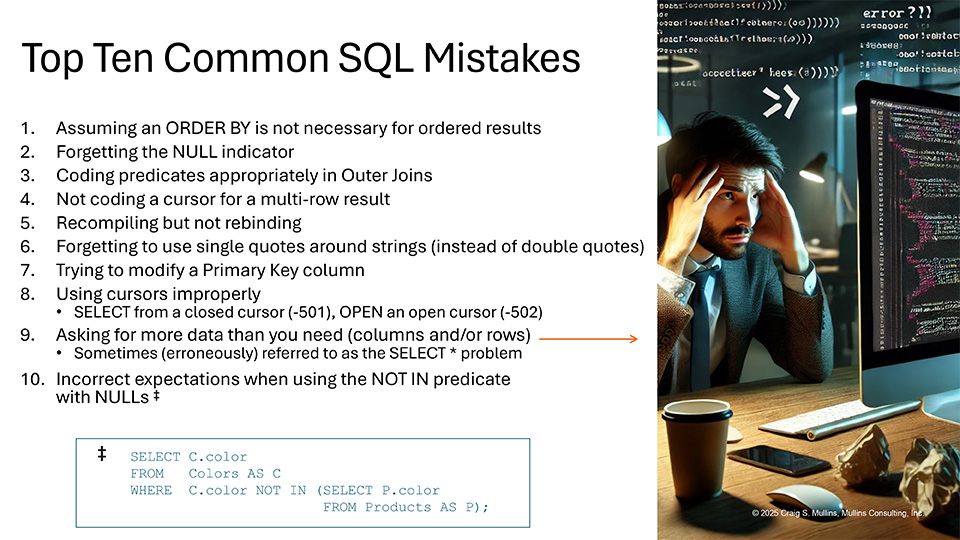
Mullins reviewed several recurring SQL mistakes, including assuming query results will arrive in a particular order without an ORDER BY clause, failing to account for nullable values, and requesting more data than an application needs.
A query that retrieves unnecessary columns may work perfectly well, but each additional column adds overhead. Across thousands or millions of executions, those small inefficiencies add up.
He encouraged developers to use relational programming techniques rather than carrying flat-file processing habits into Db2 applications. Using joins, minimizing unnecessary data access, and letting SQL perform the work can improve efficiency.
Mullins also revisited what he calls bachelor programming syndrome: the fear of committing. Applications that fail to issue commits appropriately can create lock escalation, timeouts, and other problems that could be avoided with a sound commit strategy.
Indexing received considerable attention as well. Mullins challenged the practice of imposing arbitrary limits on the number of indexes per table, recommending instead that indexes be designed around actual SQL workloads.
Query frequency and business importance should guide indexing decisions. He also discussed index-only access, using indexes to avoid sorting, and identifying unused indexes that may no longer be needed.
Db2 Features Worth Another Look
The presentation included a review of significant features introduced in Db2 12 and Db2 13, along with capabilities that organizations may not be using to their full potential.
For Db2 12, Mullins highlighted continuous delivery, relative page numbering, and piecewise DELETE operations. His Db2 13 discussion covered SQL Data Insights, utility history, application-level locking controls, and improvements to fast traverse blocks.
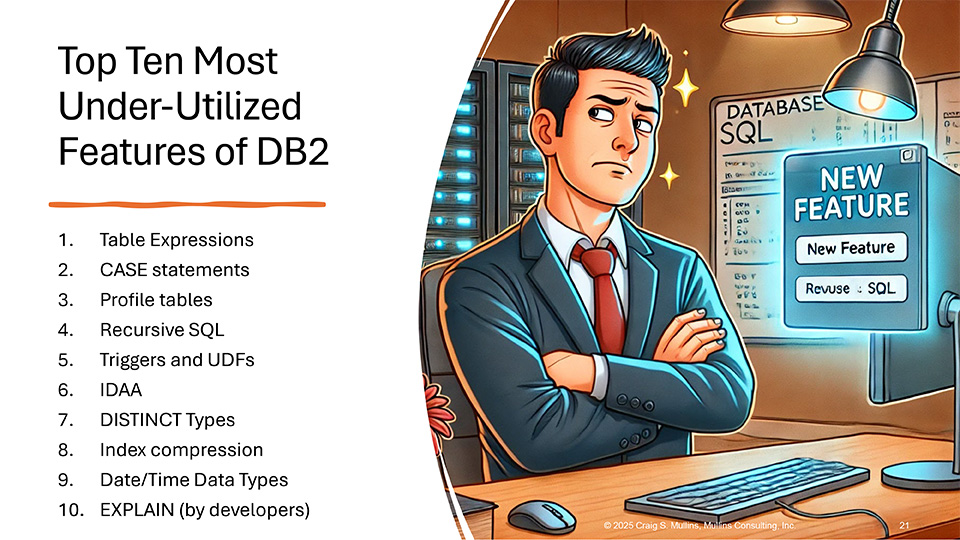
He also identified several underutilized capabilities, including common table expressions, recursive SQL, profile tables, and the Db2 Analytics Accelerator.
One recommendation was to encourage application developers to use EXPLAIN during development. Understanding access paths before an application reaches production can help identify performance problems earlier, rather than leaving that work entirely to DBAs.
Data Integrity Comes Before Speed
Despite the emphasis on performance, Mullins ranked data integrity and accuracy as the most important DBA responsibilities, ahead of availability, backup and recovery, and performance management.
He was particularly critical of the widespread use of uncommitted reads. Adding WITH UR to SQL statements may help avoid locking delays, but it can also produce inconsistent results, including duplicate rows or missing data.
Mullins cautioned against using WITH UR indiscriminately in production applications, especially where data accuracy is essential.
He also discussed the importance of database design decisions, maintaining recoverability, and understanding the business requirements behind the systems DBAs manage.
The Changing Role of the DBA
Mullins addressed broader industry developments, including AI, cloud computing, DevOps, automation, and more frequent database changes.
As development practices evolve, DBAs need more than technical expertise. Understanding business priorities, working effectively with developers, and managing change are increasingly important parts of the job.
His recommendations included documenting work, automating repetitive activities, sharing knowledge, and staying current with Db2 capabilities.
He also questioned rigid standards, particularly those built around words such as “always” and “never.” Standards have their place, but DBAs and developers should understand the reasoning behind them and recognize when exceptions make sense.
Watch the Session
Mullins covered considerably more ground during the presentation, including SQL codes worth remembering, common database misconceptions, physical design mistakes, DBA and developer frustrations, and the tools he considers most useful.
He also introduced his recent book, The Cost of Good Enough Data, which examines how shortcuts in data management and system design can create long-term problems.
The complete presentation includes Mullins’ Top 10 lists, examples, and references to additional articles for those interested in exploring individual topics in more detail.
Watch the session recording and access the presentation slides and transcript here.
About the Speaker
Craig S. Mullins is president and principal consultant of Mullins Consulting, publisher and editor of The Database Site, an IBM Champion, and a frequent speaker and author on database management and Db2. He is the author of Db2 Developer’s Guide and other books on database technology.
This session was presented as part of the Virtual Db2 User Group series, sponsored by DataKinetics.




0 Comments