




How OpenTelemetry and IBM Z® OMEGAMON® are extending end-to-end visibility into IBM® CICS® and Db2®.
For many years, IBM® mainframes have been monitored using highly specialized operational tools, including performance monitors, SMF records, subsystem traces, accounting records, dumps, logs, and expert panels. These tools could tell a skilled system programmer almost anything about the health of a z/OS® environment. That depth of insight remains essential.
What has changed is the context in which mainframe applications now run. A single business transaction may begin in a mobile application, pass through APIs, gateways, message queues, Java® services, IBM® CICS® transactions, and Db2® for z/OS data access before the user receives a response.
In this environment, traditional platform monitoring is necessary but no longer sufficient on its own. Operations teams, site reliability engineers, application owners, and mainframe specialists need a shared way to answer questions. Where did this request spend its time? Which component introduced latency? Did the failure occur before, inside, or after the mainframe? Which specialist team should investigate first? Observability addresses these questions by collecting and correlating signals such as traces, metrics, and logs across technology boundaries.
For mainframe teams, this doesn’t mean replacing proven diagnostic tools. It means connecting the mainframe into the broader observability fabric of the enterprise. The goal is to make IBM Z® a visible, first-class participant in end-to-end monitoring rather than a perceived “black box” at the end of a distributed transaction path.
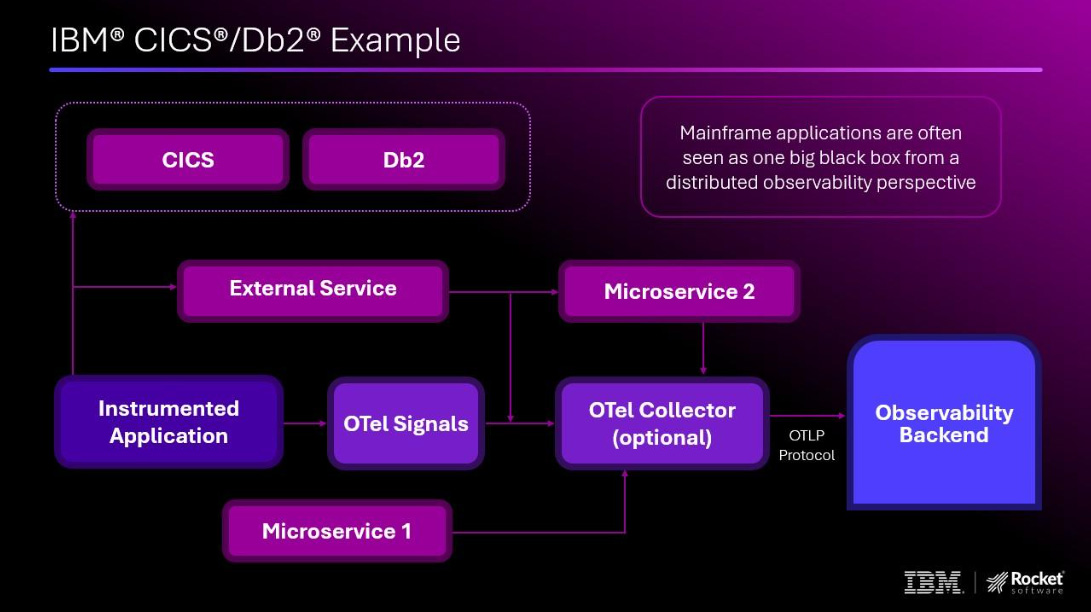
Modern observability gives non-mainframe stakeholders enough context to understand where a problem is occurring, while enabling deeper investigation with mainframe-native tools when the evidence points to CICS, Db2, MQ, IMS, or z/OS itself.
How Db2 and CICS now support OpenTelemetry traces and trace context
OpenTelemetry has become the dominant open standard for instrumenting, collecting, and exporting telemetry data in hybrid application environments. One of its most important capabilities for transaction analysis is distributed tracing. A trace represents the journey of a request across multiple components, with each participating component contributing one or more so-called spans that describe its part of the work. The relationship between spans is maintained through trace context, commonly based on the W3C Trace Context standard.
IBM has extended this model to key z/OS subsystems. CICS Transaction Server 6.3 can participate in OpenTelemetry tracing by propagating trace context to a Db2 13 subsystem and generating span data for its own tasks. CICS does not normally initiate the trace; instead, it participates when incoming work already carries a valid trace context from another component, such as a web service, z/OS Connect, CICS Transaction Gateway, IBM® MQ, or a Java application.
Db2 for z/OS has also become part of this observability model. With enhancements added to Db2 in Q4 2025, it supports inbound OpenTelemetry trace context propagation and can report individual units of work as OpenTelemetry spans. This allows a distributed trace to include database processing on z/OS, making it easier to determine how much time a transaction spends in Db2 processing or in a CICS transaction, rather than treating the mainframe as a single step in the request’s journey.
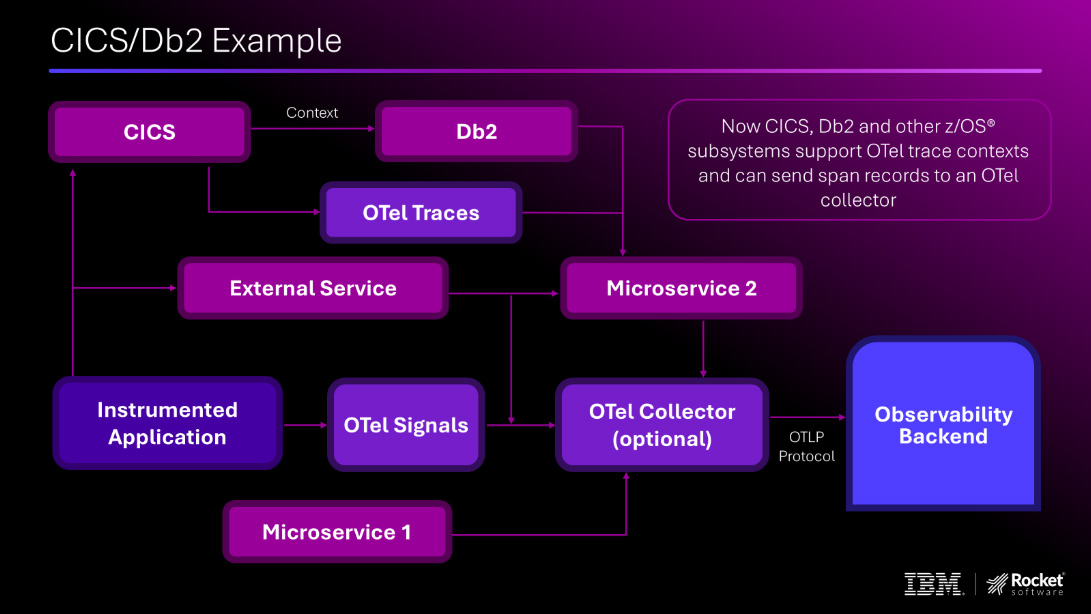
If traditional Db2 accounting trace classes are active, the spans can be enriched with familiar Db2 performance measurements such as elapsed time, CPU-related data, and thread context-related data such as correlation id or logical unit of work id.
Operationally, this is a significant step. Organizations that embark on the OpenTelemetry journey now can exploit a vendor-neutral approach to connect z/OS processing into observability back ends and collectors already used by distributed teams. A trace that begins outside z/OS can now retain its identity as the request enters CICS and reaches Db2. This helps reduce handoff friction between teams because the conversation can start from a shared trace timeline rather than from disconnected logs and assumptions.
OpenTelemetry doesn’t require programming changes in a CICS transaction nor changes to Db2 SQL statements. It just needs to be ensured that calling applications provide an OpenTelemetry trace context, OpenTelemetry support in CICS, Db2 (and other participating subsystems such as IBM MQ and IMS) is started, and the z/OS OpenTelemetry emitter can send trace records to an OpenTelemetry endpoint.
It’s equally important to set the right expectations. OpenTelemetry tracing is not a replacement for CICS trace, Db2 traces, SMF analysis, or subsystem-specific monitoring. It’s a correlation layer and triage mechanism. When a trace points to a performance anomaly, contention issue, database access pattern, or transaction-level problem on z/OS, mainframe teams still rely on their detailed diagnostic tools to determine root cause and appropriate corrective action.
Don't miss these other great articles
How OMEGAMON AI for CICS and Db2 Integrates application tracing
While OpenTelemetry is important for cross-platform visibility, mainframe specialists still need detailed subsystem context when a transaction reaches IBM Z. This is where IBM Z OMEGAMON plays a central role. OMEGAMON has long provided real-time and historical performance monitoring for z/OS subsystems, including CICS and Db2.
OMEGAMON already provides correlation between CICS and Db2. When a CICS task accessed Db2, CICS Task History could provide information about the associated Db2 thread and link directly to the corresponding Db2 Thread History Detail accounting information.
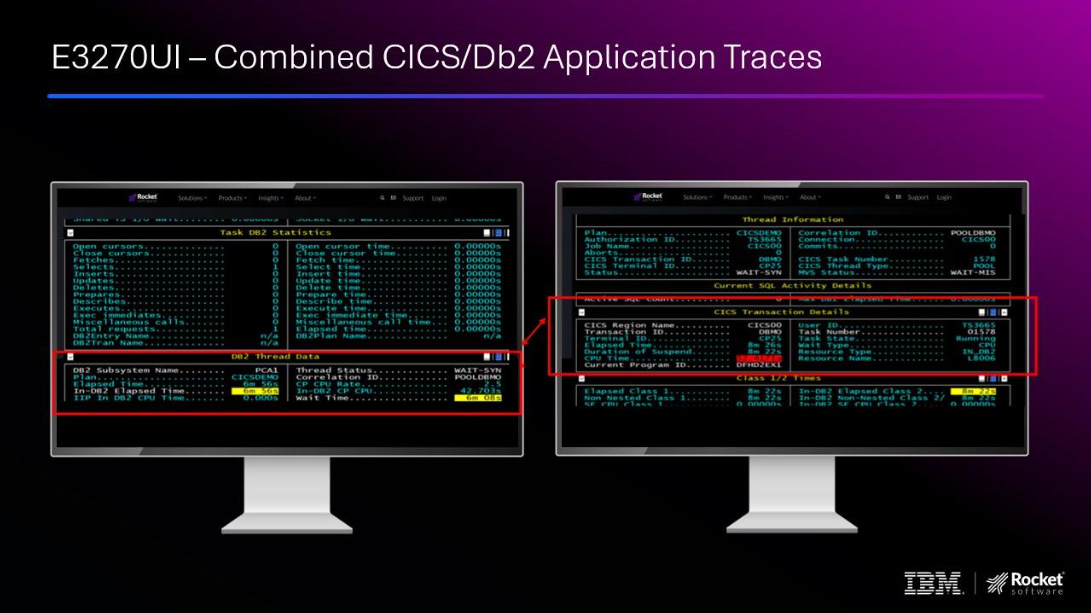
Building on this existing correlation, recent enhancements to IBM Z OMEGAMON AI for CICS and OMEGAMON AI for Db2 introduce an even deeper level of integration through combined application tracing across CICS and Db2.
In many environments, CICS is the transaction manager, and Db2 is the system of record. A user transaction may execute several CICS programs, issue Db2 SQL calls, return to CICS logic, access additional resources, and then commit or back out. Historically, investigating this end-to-end path could involve switching between CICS task detail, CICS application trace information, Db2 accounting data, Db2 application trace facility information, then manually correlating events using timestamps. That process works, but it requires experience and time.
The combined CICS and Db2 application trace view addresses this by merging CICS and Db2 application trace events into a single chronological display for a task. In the CICS Task Application Trace workspace, OMEGAMON can show a Combined tab when the required Db2 integration data is available. The result is a time-ordered view of the application flow that includes both CICS and Db2 events. Context-switch indicators show when the trace moves between CICS regions or between CICS and Db2, making it easier to follow the application flow.
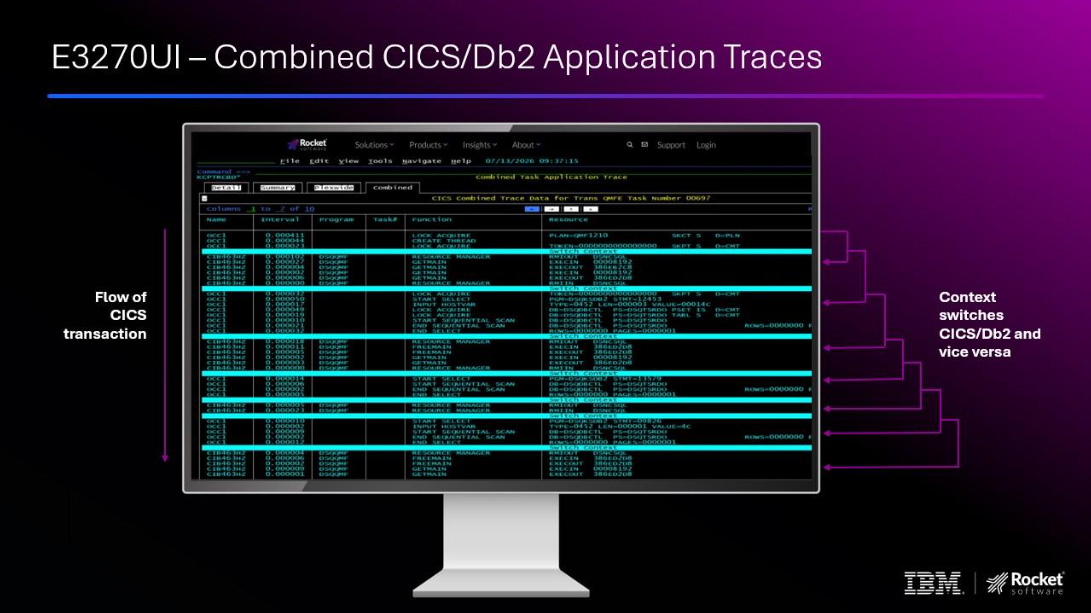
With application tracing, users can drill down to the execution of a single SQL statement. Depending on the trace configuration, it’s also possible to track associated lock and unlock requests, as well as scan and sort activity.
This capability brings valuable mainframe-native tracing closer to the way modern application teams reason about request flows. A performance analyst can see the sequence of relevant CICS and Db2 activity without manually reconstructing the timeline across separate tools. If a transaction waits before a Db2 call, spends time inside Db2, returns to CICS, or switches context, that sequence is easier to follow. The combined trace becomes a bridge between application logic and subsystem behavior.
This integration also helps CICS and Db2 teams work together during incidents, when their tools and terminology may differ. A combined trace view gives both teams a common operational artifact. It helps the CICS specialist understand when control moved into Db2, and it helps the Db2 specialist see the broader transaction context around the SQL-related work. By reducing the need to prove where the problem is not, teams can focus faster on where the evidence suggests the problem is.
The feature depends on the availability of the required trace information. Db2 application trace facility tracing must be active, and correlation information such as a Db2 accounting token must be present. For active tasks, the timeliness of the combined view depends on how quickly Db2 trace data is flushed and made available.
From an observability perspective, the immediate benefit is faster problem isolation for CICS and Db2 workloads. The broader significance is that OMEGAMON is evolving from subsystem monitoring toward integrated application-centric analysis. It remains deeply grounded in mainframe performance data, providing mainframe metrics at a great level of detail. But it presents that data in a form that corresponds more closely to the transaction journey that application owners, SREs, and operations teams care about.
How IBM Z OMEGAMON in general supports OpenTelemetry
OMEGAMON’s role in modern observability is not limited to interactive panels. IBM Z® OMEGAMON Data Provider, a component of the IBM Z OMEGAMON product stack, makes OMEGAMON monitoring data available to external analytics and observability platforms. It can stream data from OMEGAMON monitoring agents and related sources to destinations such as Instana®, Splunk, Elastic Stack, Kafka®, Prometheus, Grafana, and OpenTelemetry-capable consumers.
The OMEGAMON Data Provider supports several output methods. JSON-based push mechanisms support integration with many analytics platforms. A Prometheus endpoint enables pull-based metrics collection. OpenTelemetry output provides a path to emit operational data using the OpenTelemetry Protocol (OTLP). This is especially relevant for organizations standardizing on OpenTelemetry collectors and pipelines as part of a broader enterprise observability architecture.
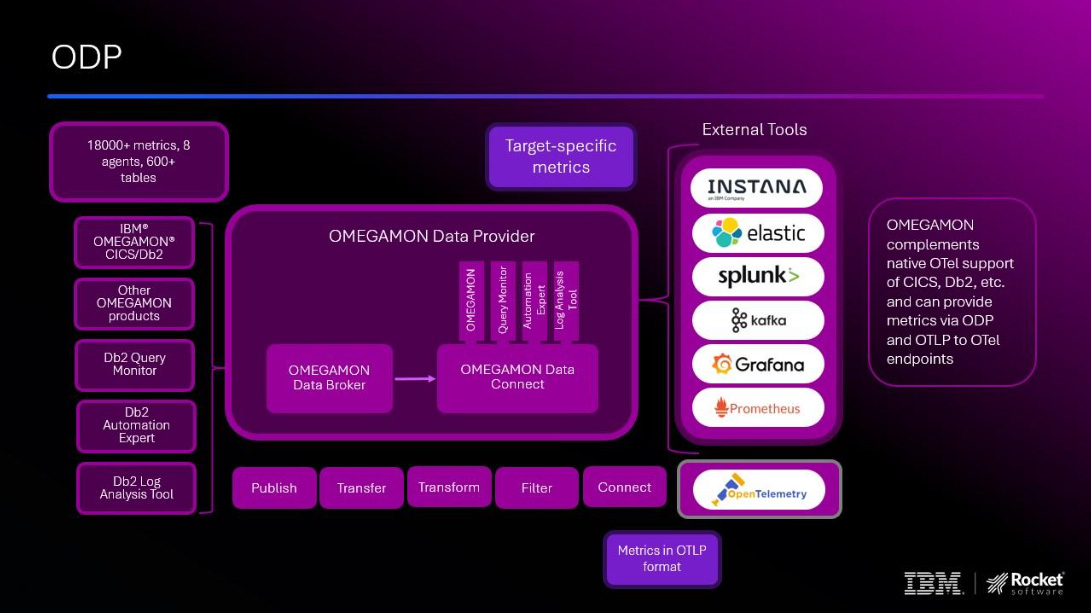
This distinction is important. Native OpenTelemetry support in CICS and Db2 focuses on trace participation for transaction flows. OMEGAMON Data Provider focuses on making OMEGAMON monitoring metrics available outside traditional mainframe interfaces. Together, they address complementary needs. Traces help explain the path of individual requests, while monitoring metrics help teams understand the health, behavior, and capacity of the environment that processes those requests.
For enterprises, this opens a pragmatic adoption path. Mainframe teams can continue to use OMEGAMON for expert analysis while also sharing selected operational data with enterprise observability platforms. Distributed teams can gain visibility into IBM Z signals without requiring direct access to every mainframe tool. SRE teams can correlate z/OS health data with application traces, dashboards, and alerts from the rest of the hybrid environment.
The key is to treat OpenTelemetry and OMEGAMON as complementary rather than competing approaches. OpenTelemetry provides standardization and cross-platform correlation. OMEGAMON provides mainframe-specific depth, operational maturity, and subsystem intelligence. When used together, they bring CICS and Db2 for z/OS as well as other IBM Z subsystems into the modern observability conversation while preserving the depth required for mission-critical workloads.
Modern mainframe observability is therefore not about making IBM Z look like any other platform. It’s about exposing the right signals, preserving the depth of mainframe diagnostics, and connecting both to the transaction narratives used by today’s application and operations teams. With OpenTelemetry support in CICS and Db2 for z/OS, combining CICS and Db2 application tracing in OMEGAMON, and OMEGAMON Data Provider integration with open observability pipelines, IBM Z can be fully integrated into end-to-end observability without sacrificing the diagnostic depth that sets it apart.
IBM CICS, IBM Z, z/OS, Db2, OMEGAMON, Instana, and CICSPlex are trademarks of International Business Machines Corporation.
 Christoph Theisen is a Senior Principal Solutions Advisor at Rocket Software, based in Germany. He joined Rocket in 2021 after more than three decades at IBM.
Christoph began his career in IBM’s Global Services unit in 1991, working on numerous client engagements, primarily focused on Db2 for z/OS, as an application developer, database administrator, architect, and consultant. Over time, his role evolved into that of a Client Technical Specialist, helping Db2 for z/OS users adopt new features, functions, and analytics capabilities across Db2 and related products. During that time, Christoph achieved a Certified Technical Specialist certification from The Open Group (Open CTS).
At Rocket Software, Christoph engages with clients using IBM Db2 for z/OS Tools, with a particular focus on IBM OMEGAMON for Db2 and Db2 Query Monitor for z/OS, ensuring they maximize the value of these solutions. He also works with customers leveraging the Db2 Connect product stack, assisting them in modernizing their Db2 data server and client infrastructure.
Christoph is a frequent speaker at conferences and user group meetings and has been recognized as an IBM Champion since 2022. At the latest IDUG EMEA conference in Porto, he presented on OpenTelemetry as well as Db2 Connect modernization and was one of the top ten speakers of the overall conference.
 Aleksandr Charcikov is a Senior Solutions Advisor at Rocket Software, specializing in IBM CICS tooling, including OMEGAMON AI for CICS, CICS Performance Analyzer for z/OS, OMEGAMON AI for JVM, and OMEGAMON Web UI. With deep knowledge of CICS Transaction Server internals, performance tuning and optimization, resiliency, CICSPlex® SM, DevOps, JVM monitoring, and observability. He helps organizations modernize and optimize their mainframe environments for greater efficiency, reliability, and operational insight.
A key part of Aleksandr’s role is working directly with customers to help them get the most value from their OMEGAMON solutions. He delivers customer training and technical enablement, helps teams troubleshoot complex CICS and JVM performance and monitoring challenges, shares best practices, and supports organizations as they adopt new capabilities and modernize their monitoring strategies. He also works closely with customers to understand their real-world requirements and pain points, helping connect customer needs with product teams and future product direction.
Before joining Rocket Software, Aleksandr spent more than a decade at Barclays UK, where he held several leadership and technical roles, including Global Head of the CICS team, CICS Technical Lead, and Head of Innovation and DevOps for Mainframe Infrastructure. He was also recognized as the Mainframe Resiliency Champion, driving initiatives that strengthened the resilience and reliability of business-critical mainframe systems.
Aleksandr is passionate about sharing knowledge with the wider mainframe community and helping make complex technologies easier to understand and use. He is a frequent speaker at industry events, including GS UK, GSE Nordic, and IBM conferences, where he speaks about CICS, JVM monitoring, observability, performance, resiliency, and modern mainframe operations. He has also presented at the WAVEZ conference, helping students and those new to the mainframe understand CICS, Java/JVM technologies, and the opportunities available within the mainframe ecosystem.
Today, Aleksandr combines hands-on technical expertise, customer experience, and industry knowledge to help organizations solve real operational challenges, improve observability, build more resilient environments, and make the most of modern OMEGAMON capabilities.




0 Comments