




Modernization can deliver tremendous business value. But cost savings only materialize when organizations understand how mainframe economics really work.
Organizations often launch mainframe modernization initiatives with a clear objective: reduce costs by moving workloads off the mainframe.
The logic seems straightforward. If fewer applications run on IBM Z, infrastructure costs should fall.
Yet many organizations discover something unexpected. After months or years of migration work, the projected savings never appear. In some cases, operating costs actually increase.
The problem usually isn’t the modernization effort itself. It’s the assumption that reducing mainframe workload automatically reduces mainframe costs.
In reality, mainframe pricing rewards scale. Hardware efficiency, software licensing, and pricing discounts all change as workloads shrink. Unless those relationships are factored into the business case from the beginning, organizations can significantly overestimate the financial benefits of modernization.
That doesn’t mean modernization is the wrong strategy. It means organizations should focus on tuning for value rather than simply reducing utilization.
Reducing CPU consumption doesn’t automatically reduce mainframe costs. Understanding how licensing, capacity, and workload interact often creates more value than simply removing another application.
Cost reduction is a worthwhile modernization objective, but it shouldn’t be the only measure of success.
Modernization Takes Different Forms
Most modernization projects fall into one of two categories workload offload or application modernization. With workload offload, organizations migrate selected applications or services from the mainframe to distributed platforms while continuing to run their remaining business-critical workloads on IBM Z.
In contrast, with application modernization, organizations don’t replace the application. They modernize by:
- Adding a web or mobile user interface
- Moving business logic to distributed platforms
- Retaining core data on the mainframe
Both approaches can improve customer experience, accelerate application delivery, and reduce technical debt. Both can also produce financial outcomes that differ significantly from those originally projected.
Why Cost Savings Often Fall Short
Lower utilization only creates savings if it reduces billable hardware or software costs.Several common scenarios prevent that from happening.
1. The Workload Was Never Driving Costs
Not every application contributes meaningfully to software licensing costs. Some workloads fall under committed licensing agreements that remain unchanged regardless of consumption.
2. Remaining Applications Consume Available Capacity
Unused capacity rarely stays unused. Existing workloads frequently expand to consume available resources, reducing the measurable impact of removing an application.
3. Peak Utilization Doesn’t Change
Many IBM licensing models are based on peak utilization rather than average consumption. If monthly peaks remain unchanged, software costs often remain unchanged as well.
4. Hardware Requirements Stay the Same
Removing one application doesn’t necessarily allow an organization to reduce processor capacity. If the hardware remains the same, much of the expected savings disappears.
5. Pricing Tiers Change
IBM pricing becomes more economical as environments grow. Removing workload may reduce total MSUs while simultaneously reducing favorable pricing discounts, increasing the effective cost of the workloads that remain.
The result is often much smaller savings than the original business case predicted.
Understanding incremental cost rather than average cost often changes the economics of an entire modernization project.
Average Cost Isn’t the Same as Incremental Cost
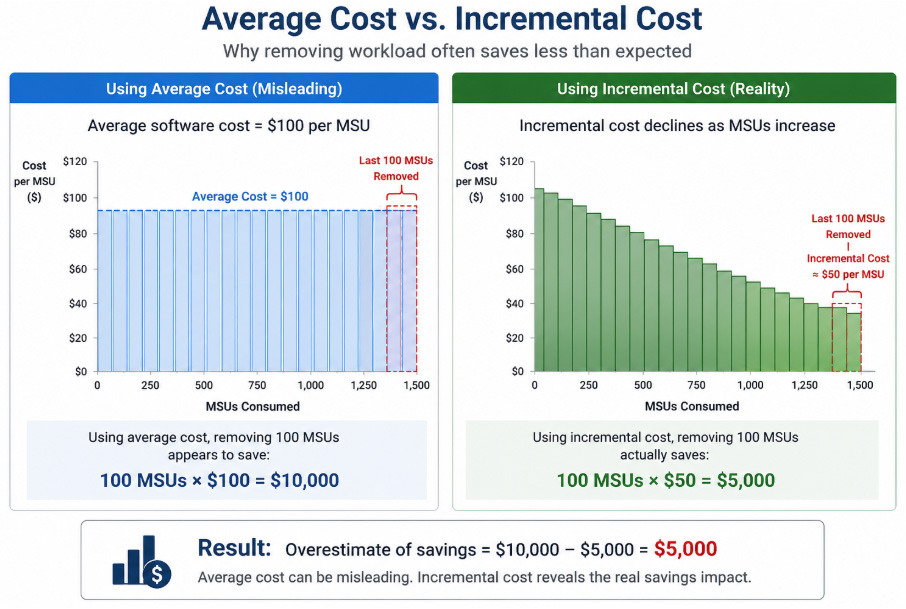
One of the most common planning mistakes is using the average cost per MSU when estimating savings. IBM software pricing is tiered. As environments grow, additional MSUs generally cost less than earlier ones.
- For example, an organization’s average software cost might be $100 per MSU, while the incremental cost of the last MSUs consumed is only $50.
- Removing 100 MSUs doesn’t eliminate $10,000 in software costs, even though the average cost would suggest it should.
- The actual savings may be only half that amount, around $5,000.
Understanding incremental cost rather than average cost often changes the economics of an entire modernization project.
Modernization Can Increase Mainframe Demand
Ironically, some modernization initiatives increase mainframe workload rather than reduce it.
Replacing a green-screen application with a modern web or mobile interface often transforms an internal business application into a 24×7 customer-facing service.
The user experience improves, but so does demand. Two examples of how modernization can increase the mainframe workload
Browsing Behavior Changes
Customers perform significantly more inquiry transactions than call center agents. Balance inquiries, account history, policy lookups, and status checks all consume resources without necessarily increasing revenue-generating transactions.
The “Star Burst” Effect
Modern applications frequently retrieve far more information than users explicitly request. A customer logging in to deposit a check or check an account balance may also trigger requests for:
- Recent transactions
- Loan offers
- Rewards information
- Payment history
- Personalized recommendations
What once required a single CICS transaction may now generate multiple back-end requests.
The customer experience improves, but resource consumption grows.
Don't miss these other great articles
Don’t Forget the Database
Many modernization projects move application logic while leaving enterprise data exactly where it belongs – on the mainframe. As a result, Db2 and other databases continue processing substantial workloads even after application logic has moved elsewhere.
Database processing and its associated licensing costs are frequently underestimated during modernization planning.
Understanding Mainframe Economics
One reason modernization business cases often miss their cost targets is a misunderstanding of what actually drives mainframe costs.
Many organizations focus first on hardware because it’s the most visible part of the platform. In reality, hardware typically represents less than one-fifth of total mainframe spending. Software licensing usually accounts for the largest share of operating costs, making it the area with the greatest opportunity—and the greatest risk—for financial modeling.
Hardware typically represents less than one-fifth of total mainframe spending.
That doesn’t mean reducing CPU utilization automatically reduces software costs.
IBM licensing models are designed around factors such as committed consumption, peak utilization, and tiered pricing. As a result, lowering workload may not immediately reduce software charges. In some cases, reducing consumption can even move an organization into a less favorable pricing tier, increasing the cost of the remaining workloads.
The lesson isn’t that IBM licensing is complicated. It’s that modernization projects need financial models that reflect how licensing actually works, and not simply how much CPU a workload consumes.
Four Cost Modeling Mistakes
Before approving a modernization initiative, understand and plan for common pitfalls. Don’t make these mistakes:
1. Use Average Instead of Incremental Cost
Savings should be based on the incremental cost of removing the workload, not the average cost across the entire environment.
2. Assume Lower Utilization Automatically Reduces Licensing
Many IBM licensing agreements depend on committed capacity or monthly peaks rather than day-to-day utilization.
3. Ignore Pricing Tiers
Reducing MSUs may also reduce valuable IBM pricing discounts, offsetting much of the projected savings.
4. Look Only at Mainframe Costs
A successful business case should evaluate the total operating cost.
Lower mainframe utilization may increase distributed infrastructure costs, cloud spending, operational complexity, software licensing elsewhere, or ongoing support requirements.
The goal isn’t to move cost—it’s to reduce total cost while improving business outcomes.
Understanding the Major Licensing Models
Organizations don’t need to become licensing experts, but they should understand how their pricing model affects modernization planning.
| Licensing Model | Business Consideration |
|---|---|
| Tailored Fit Pricing (TFP) | Predictable pricing based on committed consumption or capacity. Short-term workload reductions may not immediately lower costs. |
| Value Unit Edition (VUE) | Long-term commitments can limit savings during the contract period even when workload declines. |
| Advanced Workload License Charges (AWLC) | Enterprise pricing, where incremental MSUs become progressively less expensive, making average cost a poor estimate of savings. |
| Advanced Entry Workload License Charges (AEWLC) | Similar tiered pricing for smaller environments with different pricing breakpoints that affect incremental savings. |
The specific licensing model matters less than understanding its financial behavior.
The specific licensing model matters less than understanding its financial behavior.
Organizations should validate modernization business cases against their actual licensing agreements rather than generic cost assumptions.
A Better Way to Estimate Savings
Before approving a modernization project, ask questions beyond CPU utilization. Will the project:
- Reduce billable software licenses?
- Lower monthly peak utilization?
- Eliminate enough workload to reduce processor requirements?
- Affect IBM pricing tiers?
- Shift workload to remaining applications?
- Increase database processing?
- Introduce new customer-facing transaction volumes?
- Increase distributed infrastructure or cloud costs?
Answering these questions produces a much more realistic estimate of financial return.
Tune for Business Value
Cost reduction is a worthwhile modernization objective, but it shouldn’t be the only measure of success.
Many modernization initiatives create tremendous business value even when infrastructure costs remain relatively unchanged. Better customer experiences, faster application delivery, improved resilience, stronger security, and greater agility often justify the investment on their own.
When cost savings are part of the business case, however, organizations need realistic expectations. That means understanding how licensing, capacity planning, workload behavior, and platform economics work together before moving the first application.
The mainframe remains one of the industry’s most efficient enterprise computing platforms. The organizations realizing the greatest return aren’t necessarily the ones running the fewest workloads. They’re the ones placing the right workloads on the right platforms while making informed financial decisions.
That’s what tuning for value looks like.




0 Comments