





Is the mainframe still central to business operations — and has that changed?
The 2026 survey confirms that the mainframe remains central to enterprise operations. As in 2025, a majority of respondents report that more than half of their organization’s revenue or transaction volume depends on mainframe applications..
At the same time, the distribution across categories suggests normalization rather than decline. While 2025 saw a notable concentration in the “greater than 75 percent” segment, 2026 reflects a modest shift toward the 26–50 percent range. This movement does not indicate erosion; rather, it aligns with the broader trend of hybridization observed throughout the survey. Organizations are diversifying workloads while retaining core transaction processing and systems of record on the mainframe.
Even among organizations where mainframe-based applications account for 25 percent or less of total application workloads, respondents consistently describe those applications as mission-essential. In these environments, distributed and cloud platforms are commonly used for user interfaces, analytics, and auxiliary services, while the mainframe remains responsible for transaction execution, data consistency, and system-of-record integrity.
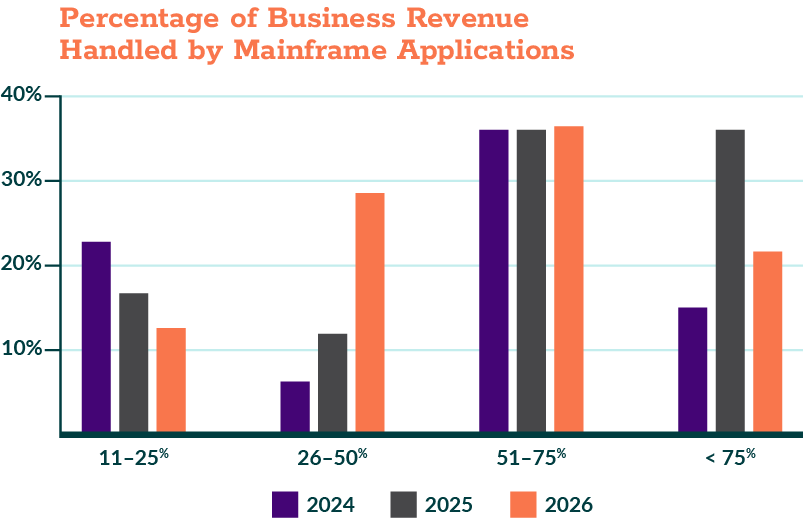
Figure 2.1: Percentage of Business Revenue Handled by Mainframe (2024-2026)
Question: What percentage of your company’s business revenue is handled by mainframe applications?
The mainframe isn’t surviving. It’s anchoring. It remains the system of record, the transaction engine, the integrity layer where truth is preserved, risk is managed, and continuity is protected. In a world obsessed with speed, it represents something rarer: stability with intention. Hybrid environments, AI integration, automation, and modernization are all advancing, but they’re orbiting the core, not replacing it. That’s not nostalgia. That’s architecture aligned to consequence.
The data indicate stability rather than erosion. The mainframe continues to anchor high-value business processes within increasingly hybrid environments.


0 Comments