





The z17 goes small, and I think that’s rather clever.
On July 7, 2026, IBM announced new configurations of the z17, and for the first time ever, you can now get a rack-mount option right across the Z and LinuxONE portfolio. Not a new processor, not a new architecture, but something arguably more interesting to a lot of shops: the same machine in smaller boxes. General availability is the 12th of August, so by the time you read this, you may have already ordered yours!
I’ll be honest, when the full-fat z17 arrived last year my first thought wasn’t, “I wish this came in a smaller frame.” But the more I read about this announcement, the more sense it makes. Let’s discuss what was announced and why I think it matters.
What’s in the announcement
There are four new boxes:
- IBM z17 single frame. A complete, enclosed unit in an IBM rack with intelligent power distribution units. Delivered ready to deploy, and you can now co-locate your own non-IBM kit in the same frame.
- IBM z17 rack mount. The Z components go straight into your own industry-standard 19-inch rack. Yes, a mainframe in your own rack. I never thought I’d type that sentence.
- IBM LinuxONE Rockhopper 5. The scalable multi-drawer LinuxONE, in both single frame and rack mount flavours.
- IBM LinuxONE 5 Express. An 18U configuration aimed at shops with a smaller set of workloads, priced as an entry point that can grow.
“Both options are built on the same flagship performance, security, and ecosystem standards IBM’s mainframe and Linux-focused hardware is known for — the difference is how, and where, organizations can physically deploy them.”
— Entrepreneur News Network
How the Smaller z17 Configurations Compare
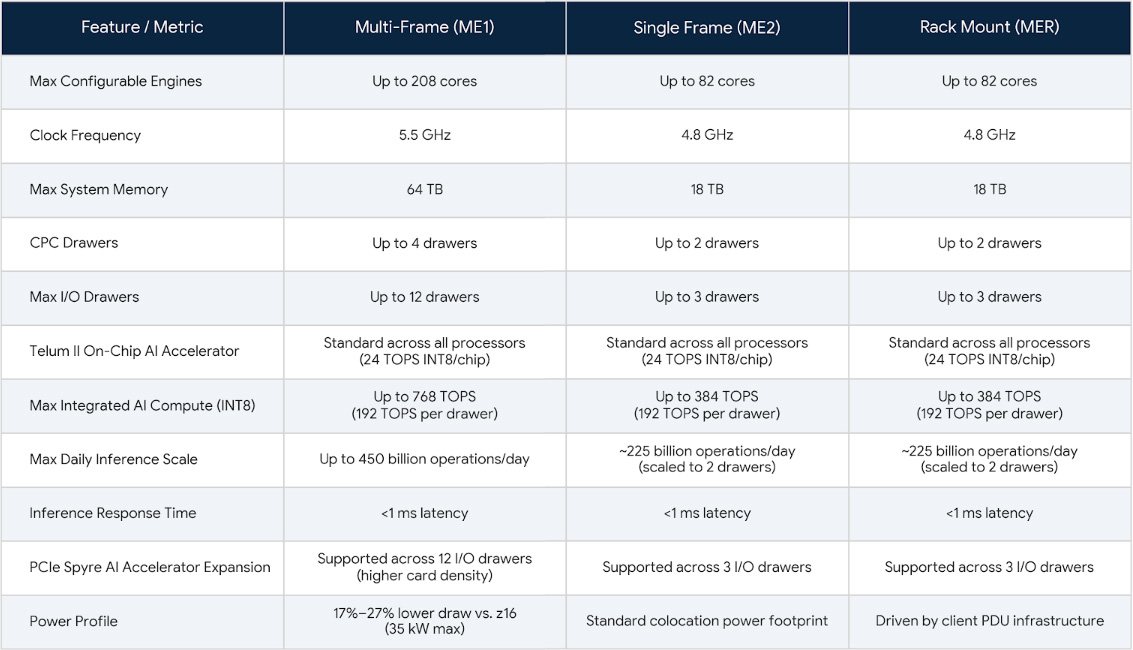
The new configurations support up to 82 cores and 18 TB of memory across two processor drawers. That’s roughly 20% more cores and 12% more memory than the previous single frame generation. IBM also quotes 10% greater throughput per core for the z17 ME2 versus the z16 A02, with the usual caveat that it varies by workload and configuration.
My standard advice applies: don’t take a single percentage at face value, go and look at the LSPR figures and the CWTL CPU Chart for something resembling your own workload mix. That’s a thought I need to get the CPU Chart updated and published ASAP.
For context, the big z17 released last year tops out at 208 cores and 64 TB, so these are proper “junior” models. But they carry the same Telum II processor with its on-chip AI acceleration, and they’ll take the Spyre Accelerator too. Post-quantum cryptography is now standard on the z17 and Rockhopper 5 systems, which pleases the security part of my brain no end.
Here’s a comparison
So who’s this for?
This is where it gets interesting. IBM’s stated aim is organisations that need the platform’s qualities of service but couldn’t justify (or physically fit) a full-scale system. At the press briefing, Rick Schoonmaker made the point that not every client in a regulated industry is a giant bank; there are plenty of smaller insurance firms and financial outfits who want the same security and compliance story in a smaller footprint.
There’s also a data centre angle I hadn’t fully appreciated. According to CBRE’s 2026 Global Data Center Trends report, record-low vacancy and rising rental rates that exceed $400 per kW per month in some markets. If you’re paying by the rack, a mainframe that lives in one of your standard racks, alongside your other kit, suddenly looks rather attractive.
Don't miss these other great articles
Looking at Linux
IBM also claims some clients have seen up to a 65% reduction in TCO by consolidating distributed servers onto LinuxONE. As ever with vendor TCO numbers, I’d want to see the workings, but the direction of travel seems right.
“These are why the majority of the world’s financial transactions are processed in IBM mainframe systems, and why many other large enterprises continue to use them, not only for mainframe workloads but also for distributed workloads in Linux systems.”
—Jonathan Gladstone, Professor and Faculty Course Lead, Georgian College
But let’s not overlook the small print about the LinuxONE5 Express: it’s designed to fit next to existing x86 servers and, even more significantly, requires no changes to cooling or power systems. Energy use for data centers is a hot topic, as we know. Perhaps this is a new angle? Read: The Race to Cool the World’s Data
Data Sovereignty
And then there’s data sovereignty. Andrew Crimmins of IBM mentioned clients wanting to peel off workloads that legally have to run in a specific country. A rack mount z17 in a small in-country facility solves that problem rather neatly.
Don’t Ignore the Software
Tucked into the same announcement were some software items that I suspect will matter more to readers of this article than the tin itself:
IBM Infrastructure Management for Z and LinuxONE (GA 14th August) brings provisioning, configuration and operations together, with Terraform and Infrastructure-as-Code support and a visual I/O topology. Anything that reduces the number of specialists needed to stand up an environment deserves attention, given the state of our skills pipeline.
IBM COBOL Elevate for z/OS (GA 18th September) promises to optimise performance for COBOL applications on z17 with “no rewrites or specialized skills required.” I’m keeping an open mind until I’ve seen it in action, but I do like that IBM is investing in the applications people actually run rather than just telling everyone to modernise.
Note: there’s also a new Crypto Discovery & Inventory capability, giving security teams a consolidated view of their cryptographic posture ahead of the post-quantum transition. If you haven’t started building a crypto inventory yet, this is your nudge.
“This announcement does one simple thing: it lowers the barrier to entry for the platform we all work on, without watering down what makes it worth working on.” —Mark Wilson
Why Now?
Officially, per IBM Chief Product Officer Tina Tarquinio, the new mainframes answer challenges facing enterprises of all sizes, including: “the need to run sensitive, data-intensive artificial intelligence workloads on-premises, to adhere to strict regulatory requirements, and [the pressures] to reduce their energy costs and data center footprints.”
Also, IBM’s leadership framed the launch as a response to record-low data center vacancy rates and rising rental costs, and the need to optimize footprints while maintaining resilience for mission-critical workloads.
Unofficially, CEO Arvind Krishna shared significantly lower-than-projected Q2 2026 financial results on July 14, 2026. The cause was “driven by a shortfall in our Z performance and the associated software stack, primarily in Transaction Processing.” As a result, the price of IBM shares tumbled a massive 25%. Offering increased tiers and pricing with the new offerings may help change the direction.
Conclusion
Strip away the press release language and this announcement does one simple thing: it lowers the barrier to entry for the platform we all work on, without watering down what makes it worth working on.
Same Telum II, same security story, same resilience, smaller box, smaller bill. For those of us who’ve spent decades hearing that the mainframe is only for the biggest of the big, it’s rather nice to see IBM proving otherwise.
If you’re an existing large shop, the sovereignty and co-location angles are worth a look. If you know someone who’s looked at the platform but never had the floor space, it might be time for a second look.
Related:
- Visit IBM LSPR for additional info.
- How AI and Mainframes Work Together: Breaking the Legacy Myth


0 Comments