





Amit Sharma, Content Creator at Tech Sharmit and Host of The Tech Sharmit Podcast, interviewed Uday Prasad, co–founder of ZedInfo Tech, about Prasad’s pivot from mariner to mainframer.
Catch the full podcast on YouTube.
Q: You have been in this industry for 30+ years. Can you take us back to where your journey began and what drew you to the mainframe industry?
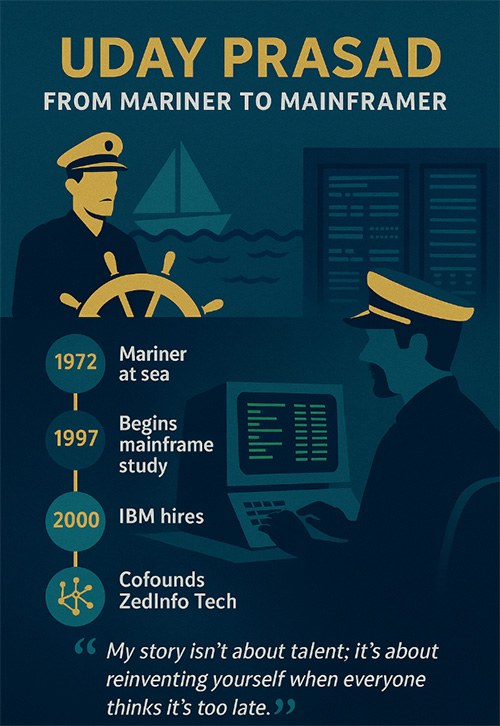
Uday Prasad: Let me take you back to 1997. After 25 years at sea fixing deck appliances, navigating choppy waters, and traveling the world, I reached a crossroads. I was in my early 40s, with a family and aging parents, and I had zero tech background. I didn’t even know the difference between hardware and software. But I had one wild dream: to become a software engineer.
I enrolled in a three-month mainframe course in India in 1997 and failed miserably. COBOL felt impossible, JCL looked like Greek, and DB2 overwhelmed me. Then one faculty member did something priceless: he wrote the names of key books on the whiteboard. I copied them as if they were a lifeline.
“I failed my first mainframe course miserably. COBOL felt impossible, JCL looked like Greek, and DB2 overwhelmed me.” —Uday Prasad
I bought those books—spending almost all my savings—and lived inside them for over a year. I practiced constantly on a crude mainframe simulator (IBM OS/2) on my home PC. No mentors, no YouTube, just me, my mistakes, and my family’s prayers.
In 2000, I sat for an IBM interview. The interviewer asked, “Why should I hire you? You’ve never worked on real projects.” I answered, “I won’t lie to you. I’m a husband and father. I don’t want a career built on lies. Test me on COBOL, JCL, DB2, VSAM, CICS. If I’m good enough, hire me. If not, tell me the gaps so I can improve.”
That honesty worked. She hired me.
“My story isn’t about talent; it’s about reinventing yourself when everyone thinks it’s too late.” —Uday Prasad
Six months later, I had proved myself: no shortcuts, just grit and books. For 30 years, I’ve thrived in a field many computer science graduates fear.
Q: Later in your journey, you co-founded Zed InfoTech. When did you decide it was time to start it, and what key moments shaped your approach to technology and education?
Uday Prasad: Yes, Zed InfoTech was founded on July 27, 2022, in Canada. The seeds were planted much earlier through my time at IBM. Immersive learning there showed me how critical mainframes really are. During training, I only knew theory, but once I started serving customers, I saw how deeply the world depends on mainframes—74% of Fortune 500 companies use them.
In India, I saw a huge gap between academic skills and vocational skills. Many people asked how I succeeded without a computer science degree. The answer: vocational training—learning by doing.
Over time, I realized my message about practical, hands-on learning often landed better outside India. That insight, together with support from my partners, led me to start Zed InfoTech in Canada.
Today, Zed InfoTech focuses on building real technical skills and professional networks, and it has transformed me from a software engineer into a vocational trainer.
Q: How has it evolved over the years?
Uday Prasad: The COBOL Excellence Center focuses on the fundamentals of COBOL—the backbone of the mainframe. If you don’t understand COBOL, you can’t modernize, migrate, or integrate with DB2 or CICS in a meaningful way.
We train students from absolute scratch. They start with their first “Hello, World” program and progress to advanced COBOL programming. Once they master COBOL, half the battle is already won. They can then quickly learn how to work with VSAM files, embed SQL for DB2, and move into CICS, which I hold very close to my heart.
Most importantly, we insist on real mainframe access. Students “dirty their hands” on a live system. The approach stays deep, practical, and hands-on.
Q: You created all the training material yourself. How do you ensure it is technically rigorous and relevant for modern enterprise environments?
Uday Prasad: First, I rely on three core values: hard work, sincerity, and honesty—values my father taught me. In 1996, my instructor pointed me toward great books, and those books still form the backbone of my library.
Three core books:
- For COBOL, my “Bible” is “Structured COBOL Programming: With Syntax Guide and Student Program and Data Disk” by Stern and Stern. I bought it in 1996 and still use it.
- For CICS, I rely on Doug Lowe, starting with his book, “CICS for the Cobol Programmer: An Introductory Course.”
- For DB2, I use Steve Eckols’ books, including “DB2 for the COBOL Programmer,” which I also bought in the 90s.
IBM manuals and Redbooks are excellent, but they can overwhelm beginners; they’re written as much for system programmers as for application developers.
“The books I use help translate that complexity into something students can actually learn from.” —Uday Prasad
I continuously invest in new books and keep expanding my library. New authors appear every year. To teach well, you must keep learning. That’s how I ensure the material stays rigorous and relevant.
Q: Mainframes are often labeled as “legacy.” Why do you believe they are still critical today, and what is your perspective on modernization and migration?
Uday Prasad: Mainframes are not legacy; they are original. They are the world’s first and most proven cloud. Modern cloud buzzwords like PaaS, IaaS, and SaaS are simply new labels for capabilities IBM created decades ago.
“Mainframes are not legacy; they are original.” —Uday Prasad
IBM now also offers MaaS—Mainframe as a Service—so you can “pay as you use,” just like any cloud platform. You don’t need to buy the physical mainframe to benefit from its strengths.
The real problem is misinformation. Young engineers are told mainframes are outdated, so companies rush into expensive migrations from COBOL to Java or to the cloud without understanding what they’re giving up.
Most enterprises still run ANSI-74 COBOL, which is unstructured and inefficient compared to COBOL-85. Many developers don’t even know how to tell the difference. Something as simple as where you place a period in COBOL can drastically affect structure and maintainability.
Before migrating, companies should:
- Do proper housekeeping: upgrade COBOL 74 code to COBOL 85.
- Measure performance and efficiency improvements.
- Explore Mainframe as a Service (MaaS).
- Invest in COBOL training instead of abandoning it.
Migration costs millions, and Java itself will eventually become “old” too. Instead of jumping from one “modern” language to another, optimize the mainframe you already trust.
To any CTO who doubts mainframes, I ask, “Can your proposed replacement handle 2.5 billion transactions a day with zero downtime?” —Uday Prasad
Mainframes can. That’s the difference.
Q: As someone who has touched many lives, who are the key people who supported your journey?
Uday Prasad: Behind every stubborn mainframe evangelist—like me—there’s a partner who quietly tolerates late-night debugging sessions and endless coding.
For me, that person is my wife, the ultimate debugger of my life’s code. Her patience and wisdom keep me grounded, and she often reminds me that even COBOL can’t run without love.
Q: If you had to summarize your entire teaching and mentoring philosophy in one sentence, what would it be?
Uday Prasad: You can’t learn to swim from a book, and you can’t master mainframes without getting your hands dirty. Every COBOL expert must go through real debugging pain to emerge steady, confident, and truly skilled. Practical struggle builds real mastery.
Q: Where can the audience find your blogs, and what topics do you write about? Also, what activities keep you inspired outside your technical work?
Uday Prasad: You can find me on LinkedIn. I’m very active there under Captain Uday. I also maintain a personal site: captainudayonmainframe.odoo.com, which serves as a repository of my blogs. I’m approaching 50 posts there, many of which Planet Mainframe has recognized and shared.
I mainly write about:
- Mainframes and COBOL
- Modernization myths
- Industry insights
- Deep technical topics and best practices
Outside of technology, I stay energized through badminton and gardening. Gardening, in fact, mirrors refactoring COBOL: It demands patience. It requires precision. And sometimes, it calls for ruthless pruning—just like cutting away spaghetti code.
Q: Thank you for joining us today. Any closing words?
Uday Prasad: Thank you, Amit. You’re doing a great job. The world needs voices like yours to highlight what mainframers can contribute—especially for those eager to learn and grow in this field.
Next Steps
See why Uday Prasad was named a 2025 Influential Mainframer
Catch more Tech Sharma podcasts on youtube.com/@TechSharmit.



0 Comments