





Artificial intelligence (AI)is no longer something CICS teams discuss in the abstract. In a recent Planet Mainframe CICS Virtual User Group, the AI conversation focused on three points:
- What is already available?
- What is already running in production?
- How is AI being introduced into CICS environments without putting reliability or transaction performance at risk?
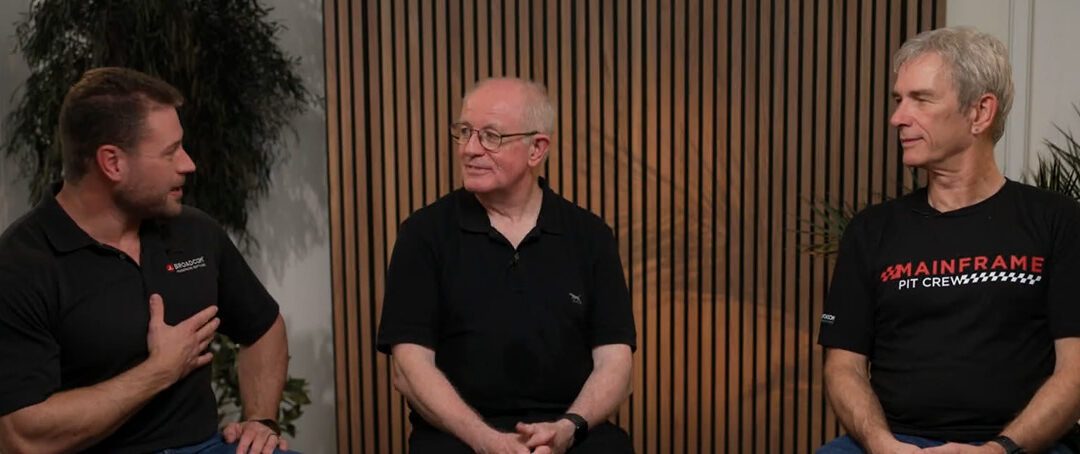
The session was led by Steve Wallin, an Executive Director at IBM with more than 25 years of experience in software development and technology leadership. Wallin oversees IBM Z software products, API and agile integration enablement, z/OS containers, and AI innovation, and he also leads the IBM Z Research and Development Labs in the UK.
AI on IBM Z
One of the points Wallin made early set the tone for the entire conversation. He said, “AI on IBM Z is not a single product or feature. It is a full-stack effort that spans hardware, operating system, middleware, and application enablement.” The goal is not to bolt AI onto the platform, but to integrate it into the same environments that already support some of the most critical workloads in the world.
Embedded AI Acceleration
At the hardware level, Wallin walked through how IBM introduced embedded AI acceleration with the TELUM processor on IBM z16, making real-time inference possible directly within transaction processing.
With the IBM z17 and TELUM II, these capabilities are further expanded, delivering higher throughput, improved efficiency, and support for extremely high-volume use cases such as fraud detection, anti-money laundering, and anomaly detection. SPire and Spyre accelerator cards extend this foundation by enabling generative AI workloads to run on the platform while keeping sensitive data co-located and secure.
What stood out in this part of the discussion was not the technology itself, but the intent behind it. AI is being designed to operate at transaction speed, in the same place as the data, rather than introducing latency or complexity by pushing decisions elsewhere.
AI is being designed to operate at transaction speed, in the same place as the data, rather than introducing latency or complexity by pushing decisions elsewhere.
AI at Transaction Speed
CICS sits squarely in the middle of this architecture. Whether the use case involves predictive models making in-transaction decisions or generative models performing text analysis and summarization, both can now run alongside core transaction processing.
Wallin grouped these capabilities into two broad scenarios: The first is infusing AI directly into applications and data, either in real time or as part of broader workflows. The second is operational excellence, including diagnostics, automation, and system management.
From there, the conversation became more concrete. Wallin outlined four AI use cases that CICS teams can already apply today:
- In-transaction inference allows AI decisions to be made during transaction processing.
- Application workflow integration connects AI models and agents to CICS services and data.
- Developer productivity is addressed through tools such as Code Assist for Z.
- Operations automation is delivered through Assistant for Z.
Four AI Use Cases for CICS Teams
In-Transaction Inference – Executing predictive AI models directly within CICS transaction flows using structured application data. Models are invoked synchronously during transaction processing to return scores or decisions such as fraud risk, eligibility, or anomaly detection, without introducing external latency or moving data off the platform.
Application Workflow Integration – Integrating AI models and agents with CICS services through standardized interfaces such as REST APIs and Model Context Protocol endpoints. This enables AI systems to discover available CICS functions, retrieve and enrich data from VSAM and Db2, and participate in multi-step business workflows alongside existing applications.
Developer Productivity – Applying AI models that are trained and fine-tuned for COBOL, CICS, and z/OS to support application discovery, code analysis, refactoring, test generation, and validation. These capabilities address limitations of generic models by accounting for mainframe-specific syntax, tokenization, and execution patterns.
Operations Automation – Using agent-based AI systems to support operational tasks such as problem determination, diagnostics, and system management. These agents interact with live CICS regions and related subsystems, gather runtime data, evaluate system state, and provide actionable recommendations while maintaining auditability and security controls.
CICS Transaction Server Version
Many of these capabilities depend on CICS Transaction Server 6.3. Wallin directly recommended that organizations still running version 5 plan an upgrade. One of the most impactful changes in 6.3 is OpenTelemetry support in CICS, which enables end-to-end tracing across hybrid application flows.
Teams can now follow transactions from APIs and messaging interfaces through CICS, into Db2 or IMS, and back again. That level of visibility changes how performance issues and bottlenecks are identified and addressed.
Developer Accessibility
Developer experience was another theme. Continued investment in VS Code integration, configuration as code, and YAML-based definitions stored in Git is making CICS environments easier to manage alongside modern DevOps practices.
Expanded support for Java, Node.js, and Spring Boot, along with updated CICS Java APIs, reflects a deliberate effort to make CICS more accessible to a broader set of developers without sacrificing the platform’s strengths.
Practical Use Case: Documentation
One of the most practical examples in the session came from an unexpected place: documentation. Wallin demonstrated how AI-generated summaries now appear alongside traditional CICS documentation on IBM.com.
These summaries draw on multiple authoritative sources and provide concise explanations, with links to the original material. Even more interesting was the ability to tailor those explanations by persona.
For example, asking for an explanation of CICS events written for a cloud architect results in a very different answer than one written for an experienced systems programmer. It is a small change, but one that has real implications for onboarding, cross-team communication, and knowledge transfer.
AI-Driven Decision Making
Modernization came up repeatedly, but not in the context of replacing applications. Wallin described how many organizations have already externalized business rules from COBOL into rules engines to allow changes without recompiling code. That same pattern creates a natural path toward AI-driven decision making.
With Decision Runtime for z/OS and Machine Learning for z/OS, CICS applications can call rule-based or inference-based models directly during transaction processing. From a CICS perspective, the interaction is intentionally simple. Structured data is passed to the inference service, a score or decision is returned, and processing continues at transaction speed.
Understanding and modernizing existing applications is another area where AI is beginning to make a measurable difference. Wallin acknowledged that generic AI models often struggle with COBOL, CICS, and z/OS constructs due to tokenization and training bias.
IBM has invested heavily in pre-training and fine-tuning models specifically for mainframe workloads, improving the accuracy of tools used for code discovery, refactoring, testing, and validation.
Evolving Application Workflows
Application workflows are evolving as well. With z/OS Connect, CICS applications can expose and consume RESTful APIs. By exposing those APIs through the Model Context Protocol, they become directly consumable by AI models and agents. This allows models to discover available services, retrieve data, and assemble responses dynamically without requiring additional custom code.
Examples such as insurance claims processing illustrated how generative models can analyze text, retrieve policy data from CICS, and present recommendations before a human agent even opens the case.
Automating Operations
Attendees were especially interested in operations automation. Wallin explained how Assistant for Z has moved beyond simple chatbot interactions into agent-based workflows. These agents can query live systems, gather evidence, and return actionable guidance.
Problem determination is currently the most common entry point, with agentic workflows significantly reducing time to diagnosis while maintaining auditability and security controls.
“AI should be treated as a tool, not a source of truth.” — Steve Wallin
In rounding out the session, Wallin emphasized that AI should be treated as a tool, not a source of truth. Its value comes from being grounded in enterprise data and from automating work that was previously difficult or impossible, not from replacing human judgment.
Key Takeaways
The takeaway from this conversation was clear. AI is already part of the CICS ecosystem, not as a disruptive force, but as an extension of the platform’s long-standing strengths.
By embedding AI where the data lives and integrating it into existing workflows, CICS teams can modernize responsibly while preserving the reliability that has defined the platform for decades. Here’s how to get started with AI in CICS:
- CICS and AI adoption are already happening in production environments, not as pilots or experiments.
- The most effective AI use cases keep inference close to the data and operate at transaction speed.
- CICS TS 6.3 is a meaningful enabler for AI readiness, observability, and modernization.
AI can improve developer productivity and operational efficiency without forcing application rewrites. - The lowest-risk starting point for AI adoption is often documentation and observability, not application code.
If you’re interested in continuing the conversation, join us at an upcoming CICS Virtual User Group. Sessions are recorded and published on the Virtual User Group YouTube channel, along with slides and transcripts, for anyone who wants to dive deeper.




0 Comments