





Maintaining and Modernizing Core Mainframe Platforms
Continuing with questions introduced in 2025, the 2026 survey indicates that organizations deliberately maintain platform currency.
Most respondents report operating on current or near-current versions of z/OS; however, adoption of the newest release is not yet widespread. A substantial share of organizations continue to run the version designated as current in the prior survey year, with an additional share remaining two releases back.
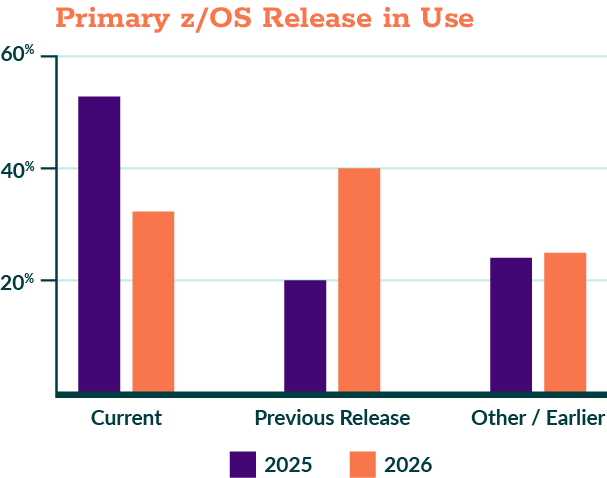
Figure 3.1: Primary z/OS Release in Use
Question: What is your primary mainframe OS release?
Importantly, no respondents report running significantly older versions, indicating that organizations are maintaining platform currency even as they defer immediate adoption of the latest release.
Taken together, these findings suggest a conservative yet disciplined upgrade strategy: organizations are progressing through z/OS releases at a pace governed by operational readiness and risk management, rather than by release timing alone.
Core Data Platforms on the Mainframe: Db2 as the Foundation
It may not be surprising that Db2 remains the dominant database platform, with nearly 90% of respondents reporting its use. This is consistent with previous Arcati survey cycles.
VSAM remains the second most frequently cited data store, and its continued use alongside Db2 reflects a long-standing architectural pattern rather than a transitional state. IMS continues to be used in environments requiring ultra-high-speed transaction processing and extreme reliability
This complementary usage highlights how organizations balance relational, hierarchical, and record-based data models to meet diverse workload requirements, rather than pursuing wholesale consolidation onto a single technology.
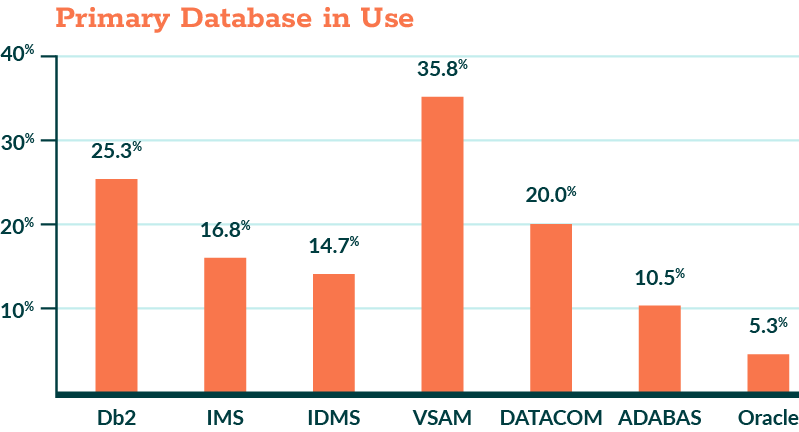
Table 3.2: Primary Databases Used on the Mainframe (2026)
Question: What databases do you use in your mainframe environment?
Db2 Upgrade Posture
Among respondents with visibility into database strategy, a slim majority report plans to upgrade their Db2 environment, while others indicate no immediate upgrade plans.
This split suggests controlled sequencing rather than uniform acceleration. Db2, like z/OS, is upgraded in alignment with operational readiness and workload risk tolerance.
LinuxOne Adoption and Role in Mainframe Environments
LinuxOne Adoption Remains Targeted, Not Universal
For the first time, the 2026 Arcati Mainframe User Survey included questions on IBM LinuxOne usage.
Seventeen percent of respondents report currently operating an IBM LinuxONE system, indicating that adoption remains targeted rather than mainstream within mainframe environments.
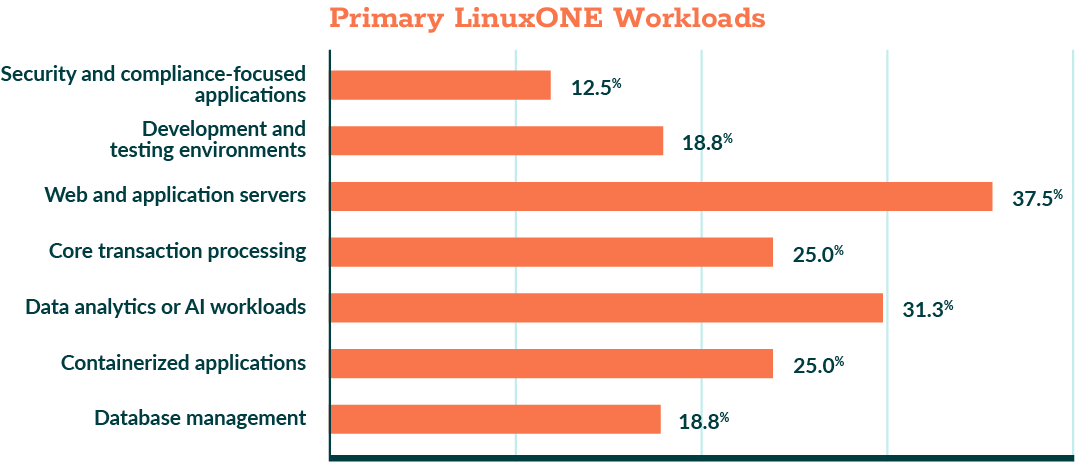
Figure 3.3: Primary LinuxOne Workloads
Question: What primary workloads or applications do you currently run on LinuxOne?
Among LinuxONE users, workloads are distributed across several categories rather than concentrated in a single dominant function.
The most frequently cited workload was Web and application servers (38%).
This was followed by:
- Data analytics or AI workloads (31%)
- Containerized applications (25%)
- Core transaction processing (25%)
Development/test and database workloads were also represented.
This distribution suggests LinuxONE is functioning primarily as a Linux-native application and analytics platform operating alongside traditional mainframe systems, rather than serving as a direct replacement for IBM Z system-of-record processing.
Architectural Role: Mixed Deployment Patterns
LinuxONE deployments reflect varied integration models:
- 44% primarily operate in isolated or standalone configurations
- 38% integrate directly with IBM Z for critical workloads
- 31% operate in hybrid on-prem/cloud environments
- 19% support cross-platform applications with minimal integration requirements
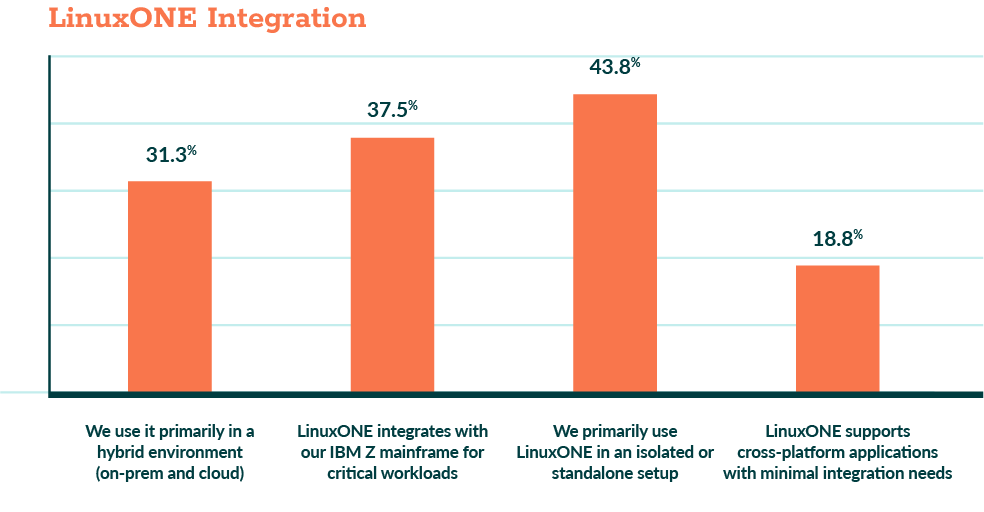
Figure 3.4: LinuxOne Integration
Question: How does your LinuxOne deployment integrate with other parts of your IT environment?
No respondents reported having zero integration with the broader IT environment.
These findings indicate that LinuxONE serves multiple architectural roles. In some organizations, it extends IBM Z environments; in others, it operates as a secure, purpose-built Linux platform with a defined scope.
Position Within AI Strategy
Broader survey data shows that public cloud remains the leading planned destination for AI workloads related to mainframe data (33%), followed by hybrid models (24%) and Linux on Z or LinuxONE (23%).
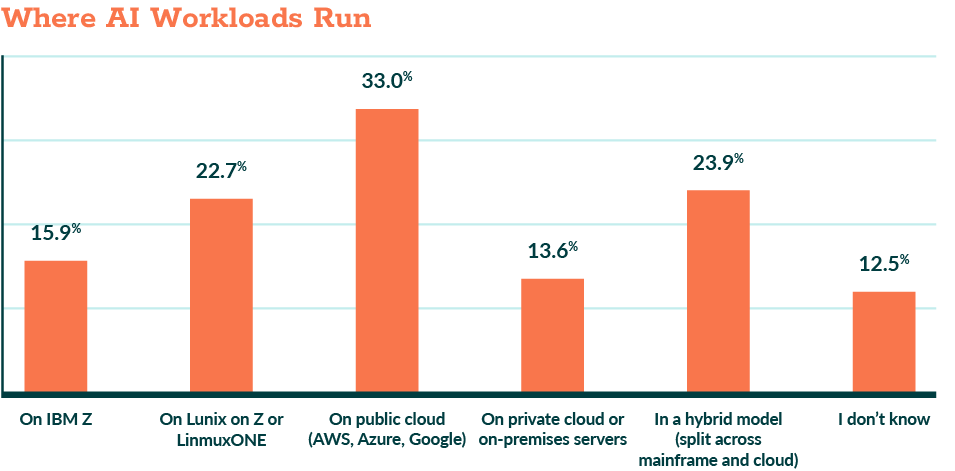
Figure 3.5: Where AI Workloads Run
Question: Where does your organization plan to host or run AI workloads related to mainframe data?
This suggests LinuxONE is participating in AI modernization strategies, but it is not currently the dominant execution environment. Instead, it appears as one option within a broader hybrid and cloud-integrated AI landscape.


0 Comments