




Why the workforce conversation needs updating
Workforce conversations in the mainframe community often default to a familiar concern: who will be left to run these systems in the future? While that question still surfaces, early signals from our 2026 Mainframe User Survey data suggest it no longer captures the full story.
Now in its 21st year, the 2026 Arcati Mainframe Users Survey is a comprehensive, vendor-independent study that provides insights into the mainframe modernization, automation, AI, security, and skills of the IBM Z user community.
This article explores primarily workforce findings from the 2026 report, based on data collected in Fall 2025. That timing matters. Workforce conditions are shifting quickly, and the most interesting signals right now are less about disappearance and more about transition.
Where skills pressure is showing up
Several workforce-related questions point to pressure that is distributed rather than isolated. The challenge is not confined to a narrow set of “legacy” roles. It is most evident at integration points, where responsibilities span systems, teams, and accountability boundaries.
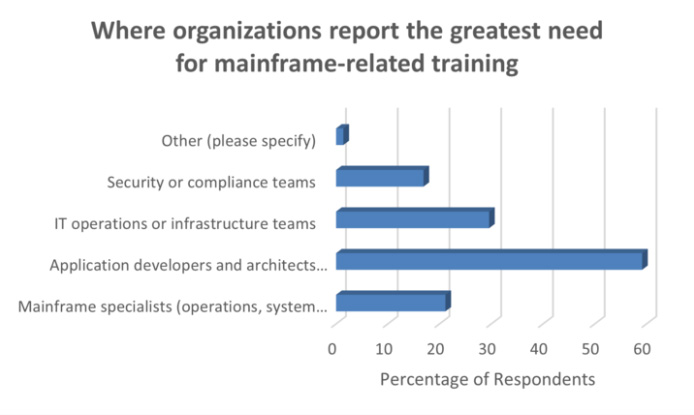
Responses to questions about skills gaps and training show strain across operations, development, security, and infrastructure teams. It is particularly evident where mainframe systems intersect with cloud platforms, modern tooling, and enterprise security expectations.
Approximately 39% of respondents report some level of skills-gap pressure. This pressure most often arises in application development and architecture roles spanning cross-platform and hybrid environments.
This can help organizations reframe workforce risk. Rather than reflecting a shortage of mainframe expertise overall, the data suggests that pressure is concentrated in areas where mainframe systems must integrate with broader enterprise architectures and delivery models.
Expanding responsibilities without changing roles
Another signal emerged from asking about multiple technical roles. Increasingly, respondents report holding more than one role, with some balancing three or more. Mainframe work increasingly spans multiple capability domains, even when job titles remain unchanged.
This does not appear as a temporary workaround. Instead, it likely reflects how work is being structured in practice—and what workforce readiness looks like inside many organizations.
Training is a standing requirement, not a fix
Training-related responses further reinforce this shift. Asking about training needs for teams, and how the organization addresses gaps show organizations investing across a mix of:
- Internal training
- Vendor-led education
- Online learning
- Mentoring
- Certifications
Training covers foundational skills and advanced capabilities in modernization, performance, security, and integration. Importantly, training is a standing requirement rather than a one-time intervention triggered by attrition or crisis.
Confidence in the platform, questions about readiness
Tension arises when workforce questions are viewed alongside individual perceptions. Many respondents express confidence in the future value and growth of the mainframe. At the same time, skills questions highlight ongoing concern about workforce readiness to support that future.
As mainframe systems assume greater responsibility for security, compliance, and enterprise-wide integration, the gap between platform and workforce confidence becomes harder to ignore.
Experience still matters, but differently
Responses to “How many years have you worked in mainframe-related roles?” show long tenures and deep institutional knowledge. Experience remains a clear strength.
What the broader survey suggests, however, is that experience alone is no longer sufficient insulation against change.
Experience alone is no longer sufficient insulation against change.
As expectations expand around integration, governance, and hybrid execution, depth increasingly needs to be paired with continuous skill development.
The big picture
Taken together, early workforce data signal a transitional moment rather than a single workforce cliff. Organizations are navigating overlapping pressures tied to integration, training strategy, and how work is distributed across teams. How those pressures are addressed will shape modernization timelines and long-term confidence in the platform.
These early workforce findings represent only one part of a broader analysis that covers mainframe usage, investment, modernization, security, and strategy. The full 2026 Mainframe User Survey report will explore themes in depth, including how they compare with prior years.
More insights from the 2026 survey will be released in February. Stay tuned!
Next
We are also interested in hearing from you about how workforce trends show up in practice. What workforce challenge feels most pressing in your organization right now? What approaches are actually working? Let’s talk about it on LinkedIn.
- Explore how mainframe careers are evolving as roles expand and expectations shift.
- Read the top 10 key findings from the 2025 Arcati User Survey.





0 Comments