





Legacy mainframes remain one of the most underestimated parts of enterprise architecture in large-scale organizations. Every second, they process thousands of transactions, store data, and handle operations.
There are still many businesses, including data-critical industries, that overlook the importance of mainframe modernization. As a result, outdated system design and technologies lead companies to high maintenance costs, making modernization seem daunting.
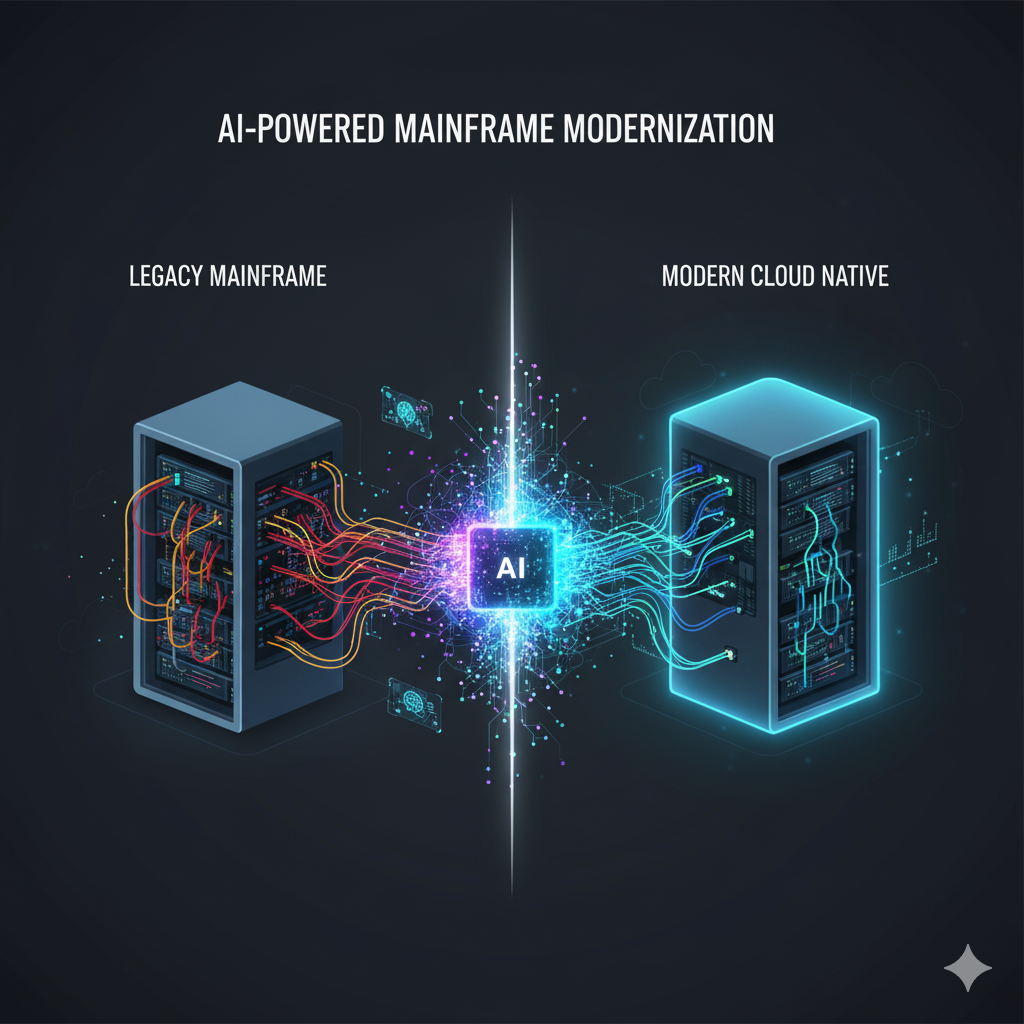
AI-assisted mainframe application modernization can solve this challenge. Leveraging generative AI, agentic automation, and hybrid cloud architectures, companies transform their legacy COBOL codebases into strategic business assets.
AI’s Role in Transformation
AI fundamentally changes how enterprises approach modernization. I’ve seen GenAI tools make a measurable difference in development cycles, including:
- IBM watsonx Code Assistant
- GitHub Copilot for COBOL
- AWS Transform for Mainframe
- Google Gemini
These tools analyze complex COBOL code and can even generate new code components, saving time and focusing workloads.
The most powerful concept is the combination of AI’s speed with human intelligence. While AI handles mundane tasks, developers can focus on strategic architecture design and innovation.
Resource Allocation and Operational Flexibility
AI-powered modernization makes a difference in human and technical resource allocation.
By automating significant portions of code analysis, generative AI solutions reduce the reliance on highly specialized legacy COBOL experts for routine or complex refactoring tasks.
This frees organizations to reallocate their most experienced personnel to architectural design, strategic planning, quality assurance, and innovation. Younger developers can become productive on mainframe projects much faster, aided by AI tools.
AI becomes a true business driver: it shifts mainframes from rigid, slow-moving platforms into agile engines for growth.
AI enables organizations to rapidly adapt their core business systems, whether responding to new market demands, regulatory changes, or evolving end-user expectations. This is where AI becomes a valid business driver: it shifts mainframes from rigid, slow-moving platforms into agile engines for growth.
Case Study: Logistics Transformation
Recently, a major logistics company and an IBA Group customer undertook a large-scale modernization of its supply chain optimization platform. Integrating GitHub Copilot for COBOL, the team transformed critical modules into a cloud-native Java environment.
Of course, there were challenges—AI-transformed code required continuous testing. We implemented change management to help developers trust AI outputs. Additionally, the undocumented or “spaghetti” legacy code required careful handling.
However, the results are impressive:
- Modernization timelines were reduced by more than 50%, enabling the faster deployment of predictive delivery route optimization tools.
- The company gained scalability and flexibility, providing instant booking confirmations and dynamic spot-rate calculations for shipping services.
It’s just a reminder that AI is powerful, but not magic.
Critical Success Factors for AI-Assisted Mainframe Application Modernization
Organizations that succeed in AI-assisted modernization share several traits.First, they have a clear vision. Modernization must align with specific business goals, such as faster customer service, regulatory compliance, or new product innovation.
The organizations will also have appropriate toolkits for their needs. The right AI tools must match the legacy environment, modernization goals, and enterprise infrastructure. Projects often fail when teams choose tools without considering their compatibility with legacy COBOL code, for example.
This also means taking an agile approach. It’s a standard recommendation in any business to start with high-value areas and deliver early wins, rather than attempt to reach a full-scale “big bang” modernization. It’s true here too.
Finally, success will require skilled teams. Developers must be trained to validate, refine, and trust AI outputs. Without this human oversight, AI’s potential is wasted.
The enterprises that succeed will combine the best of AI and human expertise
How to Address Legacy Challenges?
Legacy code quality, organizational inertia, and skill gaps are the main obstacles to successful modernization. But they all have solutions. Organizations can address them by:
- Conducting a code review to figure out challenges.
- Implementing comprehensive testing to ensure the functional equivalence of AI-transformed code.
- Managing change effectively through communication, pilot programs, and involving developers in AI tool selection and fine-tuning.
- Investing in upskilling existing staff, combining mentorship with training programs, and strategic hiring to bridge AI and modern development expertise.
AI-assisted mainframe modernization is a strategic imperative.
The Future Trends in AI-Assisted Mainframe App Modernization
Looking ahead, we expect several emerging AI capabilities to transform enterprise digital transformation over the next 3–5 years. They include:
- Automated AI-powered legacy data and mainframe modernization.
- Deep integration of AI to intelligently re-architect applications for cloud-native performance.
- AI and human collaboration across all stages of development.
- Ensuring ethical AI with government compliance.
Conclusion
If you’re still wondering if AI on mainframes will really happen, the answer is yes; AI-assisted mainframe modernization is a strategic imperative. Organizations that adopt this approach gain agility, innovation, and reduce costs in the long term. The enterprises that succeed will combine the best of AI and human expertise, turning mainframes from perceived constraints into exceptional end-user experiences.
The question is not whether to modernize, but how quickly organizations can leverage AI to transform legacy assets into future-ready platforms. The sooner leadership acts, the sooner these companies can claim leadership in the digital economy.





This is a refreshing take on mainframes—less “legacy burden” and more “untapped strategic asset.” I appreciate the balanced view that AI is powerful but not magical; combining generative AI with strong governance, testing, and skilled teams is clearly the winning formula. The real insight is that modernization isn’t just technical refactoring—it’s business acceleration. With tools like IBM watsonx Code Assistant and GitHub Copilot supporting COBOL transformation, mainframes can truly get their AI glow-up—evolving from rigid systems into agile, innovation-ready platforms.